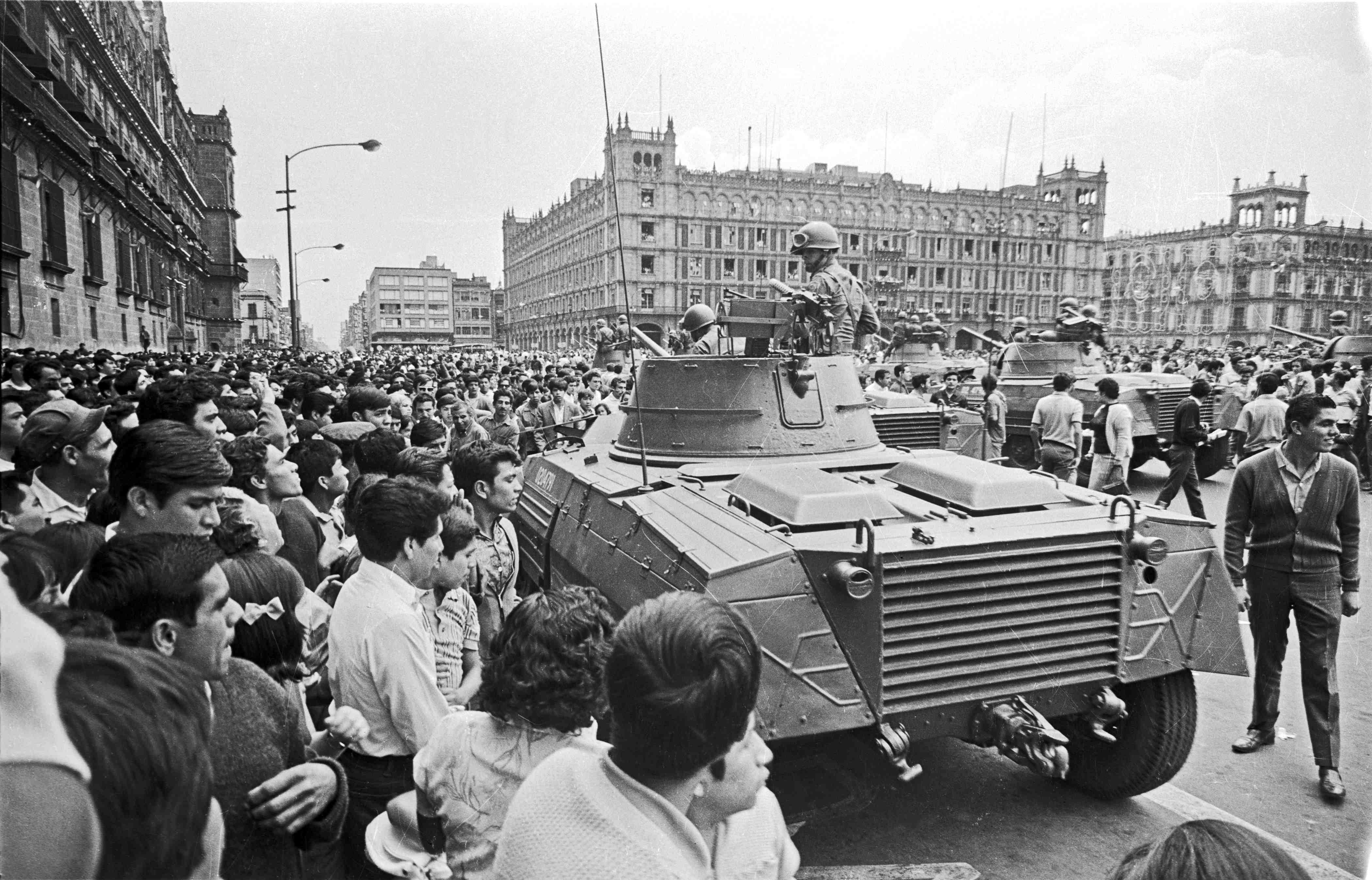
Military Forces Disrupting One of the First 1968 Protests in Mexico City
From Czechoslovakia and its Prague Spring to the Civil Rights movement in the United States, the year 1968 is historically remembered for widespread protests and sociopolitical unrests across the globe. This social turmoil and thirst for justice also swept through Latin America, a region marked by political violence and repression. Latin America became the scene of numerous massacres and violent confrontations involving governments, civilians, organized movements, and paramilitary groups.
Some of the students who were arrested by the Olimpia Battalion and forced to stay half-naked
One of the most tragic instances of political violence in Latin American history is the Tlatelolco student massacre in Mexico City. On October 2, 1968, following a series of confrontations with police and military forces, university students, workers, and civilians gathered at La Plaza de las Tres Culturas, in the Tlatelolco district of Mexico City to peacefully protest against the political violence and repression that was taking place across the nation. Few could have anticipated that the Mexican government would reveal its most brutal and violent side that very day.
La Paloma de la Paz (The Peace Pigeon)
At around 5:50 PM, red flares were fired above the manifestation; twenty minutes later, two more flares were shot, signaling the military to attack. Soldiers and members of the paramilitary group known as “Batallón Olimpia” began shooting at the crowd. Troops, tanks, and trucks surrounded the Plaza; the unarmed civilians had no way out. An overwhelming number of bodies littered the area—students, women, and even children lay dead across the Plaza. To this day, no one knows the exact number lives lost that day. The following morning, no one in the news mentioned the incident, and students and most of the movement leaders were nowhere to be found.
Over the years, the Tlatelolco massacre and the Student Movement of ’68 have come to symbolize Mexican social movements and political repression in Latin America. Both the movement and the massacre have been referenced widely in popular culture and the arts. The most notable example is Elena Poniatowska’s masterpiece La Noche de Tlatelolco, a collection of interviews she conducted with witnesses, members of the student movement, and other informants.
The Holy Mountain (1973), Alejandro Jodorowsky
The massacre has also been depicted in numerous international films. In his avant-garde masterpiece, The Holy Mountain (1973), Chilean-French filmmaker Alejandro Jodorowsky presents an allegory of the Tlatelolco massacre. In one horrowing scene, a group of young protesters is confronted by what appears to be a police force. After a few explosions fill the air with smoke, the police bathes the protesters in red, symbolizing the bloody confrontation that took place between the students and the military forces in Tlatelolco. One of the moments that particularly caught my attention in this scene was when a police officer pulls a pigeon out of a young woman’s body. The image of a pigeon served as s a powerful symbol for the Mexican Student Movement of 1968, representing peace and serving as the banner of the movement from its beginning.
Ever since I first heard about this tragic event, the Mexican Student Movement of ’68 and the massacre of October 2 became topics of personal interest to me. After reading Poniatowska’s La Noche de Tlatelolco, I gained a deeper understanding of the movement’s origins and the horrors endured by its survivors. One of the reasons I decided to write about this topic today, and particularly highlight Jorodowsky’s allegory in his film, is that not many people outside the Latin American academic sphere are familiar with it. The Holy Mountain is a widely recognized film, yet very little has been written about the social and political criticisms portrayed in Jodorowsky’s masterpiece, particularly the allegory of the Tlatelolco massacre.
Today, the Tlatelolco massacre remains a sobering reminder of the lengths to which authoritarian regimes will go to surpress dissent. It also underscores the enduring power of art and literature in preserving historical memory and fostering critical reflection. By revising these events through works like La Noche de Tlatelolco and The Holy Mountain, we not only honor the victims but also continue the fight for justice and transparency in the face of oppression.
References
Poniatowska, Elena. 1990. La Noche De Tlatelolco: Testimonio De Historia Oral. Mexico, Mexico: Era.
Figure 1.1 “By ‘the public sphere’ we mean first of all the realm of our social life in which something approaching public opinion can be formed” (Habermas 75)
Over the past
decades the invention of internet and the development of social media have
taken mass media and communications to a completely different level. The
different networks have made it easier for the masses to communicate and share
ideas by transforming any public space of communication into a broader and
world-wide zone of ideological interaction and public opinion through a virtual
platform. We read, watch, share and comment any content that we encounter in
our social media fee in a daily basis. By doing so we are not only contributing
our ideas to the topic being discussed, but we are unintentionally joining a
community, a discussion thread, a space as similar as Habermas’ Public Sphere.
Despite promoting ideological interaction and acting similarly to a space of
public discussion, social media fails to follow Habermas’ original model of the
public sphere.
The term “public sphere” was originally coined by German philosopher Jürgen Habermas who defined it as “the realm of our social life in which something approaching public opinion can be formed” (Habermas 75). Through this space everyone is guaranteed the right to publicly express their beliefs and interact with others. However, Habermas’ public sphere ideally opted for a space in which democratic expression was allowed. He viewed modern democracy as the only political ideology that could guaranteed this type of interaction between the state and the citizens (Habermas 77). Habermas emphasizes on the bourgeois-liberal model of the public sphere. The bourgeois model of the public sphere, as he explains, always included ideological components, mainly focusing on the spread of democracy and similar western practices.
Figure 1.2 If the School of Athens had been painted in the 21st Century it would look like this.
Thus, thanks to the public sphere, the concept of ideology ceased to be an abstraction and became important for the spread of democratic views and political concerns, especially those raised by the dominant groups (Williams 61). Nevertheless, by the 19th century, a new wave of social movements and revolutions around the world challenged the traditional bourgeois model of the public sphere. The raise of the newspaper industry, or business, assumed an important role on the way public sphere debated political and social matters. Habermas highlights how “the appearance of newspaper meant joining the struggle for freedom and public opinion, and thus for the public sphere as a principle” (Habermas 78). The printed media opened a new way for the citizens not only to inform themselves but also to communicate their concerns and to express their views.
According to Habermas, the emergence of the public relations industry, the increased role of advertising and the increased concentration of ownership of media, caused the public sphere to weaken during the 20th century. Habermas’ theory opposes the idea of conflict and strongly disagrees with any ideological difference since he believes that the public sphere ideally allows democratic representation and when the dominant groups are challenged the public sphere is damaged (Fraser 2005). Similarly, over the past two decades the public sphere has been altered by changes in society, but in this case the alternation has taken it to a different level. The creation of internet and the development of social networks impacted communication in both negative and positive ways.
As observed in the past two decades, social media has facilitated the spread of news and political debates as well as openly created a place for public interaction and discussion. Due to the speech limitations and censorship on behalf of the companies which have resulted from extreme political and ideological disputes between its users in the past years, social media neglects the creation of a public sphere. Scholars around the world have argued that with the creation of social media platforms, the public sphere – which some believed had disappeared – has not only returned to society but evolved and become a more challenging zone for debate and public opinion (Kruse, Norris and Flinchum). It is common nowadays to read and make any political statement on social media sites like Twitter and Facebook. However, others believed that social media lacks the fundamental principles associated with Habermas’ public sphere concept. According to the results of a research held by Lisa M. Kruse, Dawn R. Norris and Johnathan R. Flinchum, 72.4% of the participants enrolled in this research reported lack of civil discourse in social media when it comes to political opinions (2018). This shows that the existing interaction between users does not entail what Habermas’ believed was essential for the public sphere, this being the complete freedom of expression.
In figure 1.3 we observe a thread of comments between social media users regarding current political issues.
The use of social media platforms has, in a way, replaced the way we receive news and substituted most of the news channels aired in TV. The documentary Digital Disconnect shows how these new ways of communication have benefited or affected democracy and the way citizens are being informed about the government and its decisions. According to this documentary, the citizen’s opinion regarding internet and social media is divided into two categories: the internet skeptics and internet celebrants. On one side we have a group of people arguing against the internet and claiming how its development helped “an assortment of alt-right nihilistic trolls that used to operate in the fringes of American society [to be] now able to spread hatred and sensationalist fake new” (Digital Disconnect 2018). On the other side, we have the internet celebrants, those who believe in the “net effect” and its positive effect on democracy.
For the internet
celebrants, the internet has provided a tool for its users to participate more
directly in democratic polls and processes. Internet, some claim, has helped
with the spread of democratic principles, and the most common example heads back
to the Arab Spring. In 2010-2011, a series of protests and demonstrations took
place in Middle Eastern countries that were eagerly trying to democratize. During
these revolts, the main media tool used to inform and communicate was the
internet (Digital Disconnect 2018).
In such case, the internet indeed showed how it could benefit democracy. Nevertheless,
nowadays the internet has also provided great amounts of non-reliable information
sources, opening a new space for the so-called “fake news.” The spread of misinformation
on the internet can also impact the way we perceive our world and how we make
choices.
Finally, some scholars have also argued that companies like Facebook and Twitter have no other goal but to make profit out of the users. Christian Fuchs is a great advocate for this belief. He claims that companies like Facebook sell their users data to advertising companies without notifying its users. By doing this, Facebook earns profit out of the information and content of its users, whom do not receive anything in exchange and who are infinitely exploited (Fuchs 141). As we start to look more into it, we realize how the purposes of these platforms go beyond the development of new and better tools for communication, these companies also aim for the expansion of capitalism – an aspect that should be reconsidered through a Marxist perception of ideology.
Digital Disconnect. Dir. Media Education Foundation.
Media Education Foundation, 2018. Kanopy. Web. 27 Feb. 2019.
Jürgen Habermas, “The Public Sphere,” in Media and
Cultural Studies: KeyWorks, 2nd ed., eds. Meenakashi Gigi Durham and Douglas M.
Kellner, pp. 75-79. Malden, MA: Blackwell 2012
Lisa M. Kruse, Dawn R. Norris & Jonathan R. Flinchum (2018) Social Media as a Public Sphere? Politics on Social Media, The Sociological Quarterly, 9:1, 62-84, DOI: 10.1080/00380253.2017.1383143




 Social Media and the Public Sphere